Yousician Alternative for Singing: Voice-Only Training, Not One Instrument of Five
 By Kirill Zolygin
Short answer: If you want a Yousician alternative that exists only for singers, that is Time to Sing. Yousician is a gamified, multi-instrument learning app (guitar, piano, bass, ukulele, and voice) with real-time pitch feedback and a huge song library. Time to Sing is built only for singers, with style-specific technique training for Pop, Musical Theatre, and Classical, and its own real-time feedback tool, the Voice Tuner, built specifically around the singing voice instead of adapted from a generic instrument-tuning feature. If singing is your actual goal, not a side option next to guitar, Time to Sing goes deeper on the thing that matters: technique, with feedback to match.
What Yousician is built for
Yousician is one of the best-known names in music education apps, with roughly 200 million installs across its family of apps and around 20 million monthly users. Its singing mode uses your microphone to score pitch accuracy in real time, with a small dot showing exactly how far off a note you are, and it walks beginners through breathing, resonance, pitch, and rhythm inside a fixed, level-based curriculum.
That structure is genuinely good for absolute beginners who want a linear path and don't mind a gamified, streak-driven format.
Where it falls short for singers specifically
Voice is one of five instruments inside Yousician, and the app doesn't treat it as a specialty:
- No vocals-only plan. Premium costs the same (around $19.99/month, or about $10/month billed yearly) whether you picked singing, guitar, or ukulele. You're paying for an instrument-agnostic subscription, not a singing-focused one.
- The curriculum runs out of depth. Concepts that matter once you're past the basics, like mix voice, register transitions, controlled belting, or vocal-type-specific coordination, aren't meaningfully covered. Singers who finish the pitch-fundamentals track often hit a wall.
- No style-specific technique. There's no separate track for singing pop versus musical theatre versus classical repertoire, even though those styles use the voice very differently.
- Pitch detection struggles with real-world noise. The most commonly reported technical complaint is missed or inaccurate pitch recognition in shared living spaces or untreated rooms, which undercuts the app's core feedback loop.
Real-time feedback: Yousician's dot vs. Time to Sing's Voice Tuner
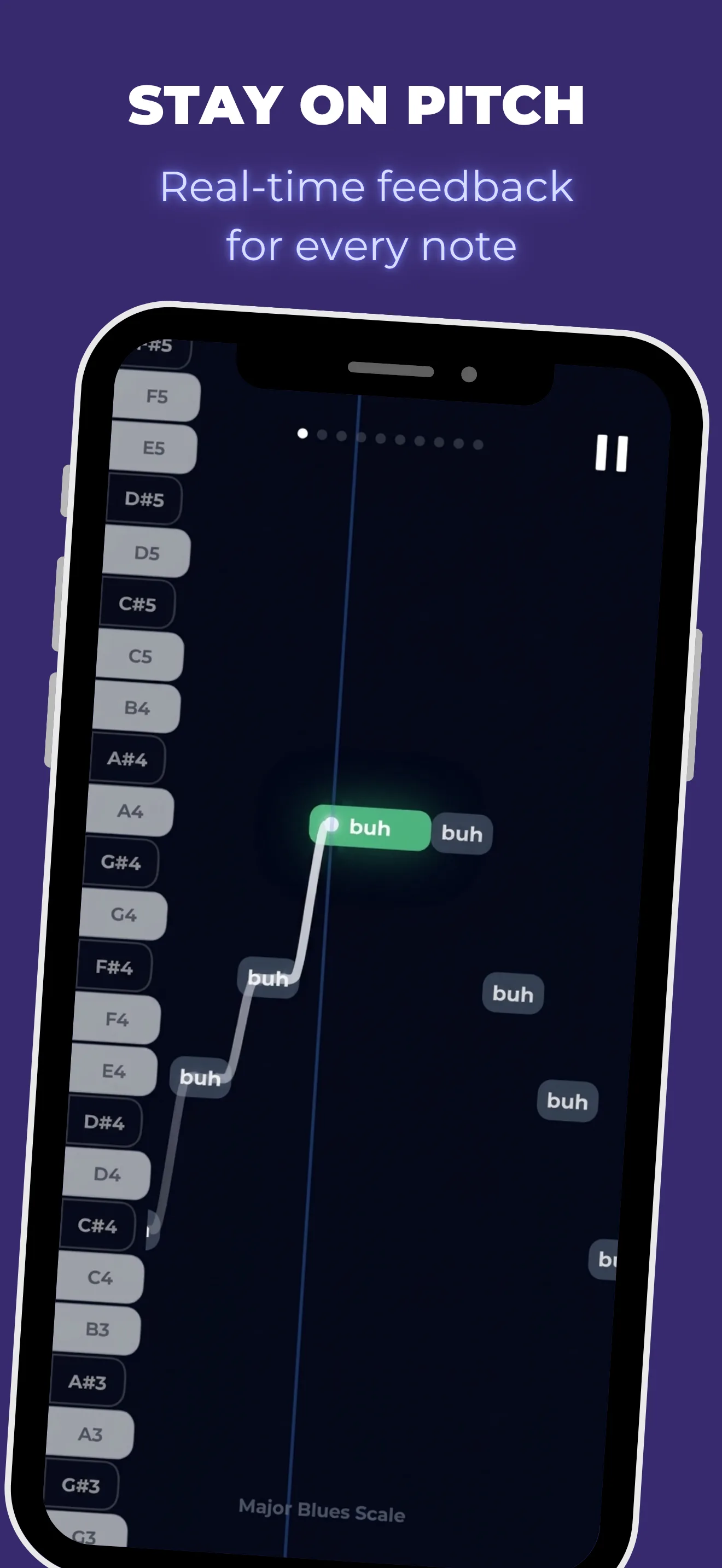
Yousician's headline feedback mechanic is a small dot that shows how far off pitch you are. It's a solid idea, borrowed from the same real-time pitch tracking Yousician uses for guitar and piano, and then applied to voice.
Time to Sing takes the opposite starting point: real-time feedback built only for singers, starting from where your voice actually sits.
- Find Your Range, first. Before training starts, a quick Voice Range Check has you sing two comfortable notes, low and high, and the app recommends a starting range. Every exercise is then matched to that range, so you're training in a zone your voice can actually grow from, not a generic default.
- Watch every note turn green. The Voice Tuner shows target notes scrolling across a piano-roll style display, matched to real melodic exercises, and each note turns green the instant you land on pitch. It's immediate, visual, and specific, not a single wandering dot shared across five different instruments.
- Feedback that scales with your range and level. Exercises adapt to your specific vocal range (bass/baritone, tenor, alto, soprano) and difficulty level, plus a dedicated breath-support mode for breathing drills, so as your comfortable range grows, the training grows with it, at your own pace, whether you're a complete beginner or a working performer.
What else Time to Sing does differently
Time to Sing is also organized around the idea that a pop belt, a musical theatre mix, and a classical head voice are not the same skill:
- Style-specific training. Separate exercise tracks for Pop, Musical Theatre, and Classical, each targeting the technique that style actually demands, from microphone technique and vowel brightness in pop to breath support and pure tone in classical.
- Taught, not just scored. Every exercise starts with a real vocal coach demonstrating and explaining the sound on video, then moves into guided audio practice you can sing along with, useful whether you're singing your first exercise or running a full warm-up as an experienced performer. You're not just chasing a dot; you're learning what the coordination is supposed to feel like.
- Offline downloads. Save exercise videos and audio locally so practice doesn't depend on a stable connection.
- Habit tools built for daily practice. Custom playlists, curated practice sessions for specific situations, and reminders with your own wording, plus simple stats on daily and weekly practice time.
Price
- Yousician: ~$19.99/month (or ~$119.99/year), covering all instruments, voice included.
- Time to Sing: Free tier with 2 exercises per style, then €9.99/month for full access to style-specific training, the Voice Tuner, offline downloads, and unlimited favorites.
Feature Comparison: Time to Sing vs. Yousician
| Aspect | Time to Sing | Yousician |
|---|---|---|
| Focus | Singing only | 5 instruments (voice, guitar, piano, bass, ukulele) |
| Platform | iOS and Android | iOS and Android |
| Real-time feedback | ✅ Voice Tuner — target notes turn green on pitch, on a piano-roll display | 🟡 Pitch-accuracy dot |
| Starting point | ✅ Voice Range Check recommends your range before training starts | 🟡 Fixed curriculum, not matched to your range |
| Style-specific training | ✅ Pop, Musical Theatre, Classical | ❌ None |
| Technique depth | ✅ Covers mix voice, register transitions, controlled belting | 🟡 Runs out of depth past pitch/rhythm fundamentals |
| How exercises are taught | ✅ Video demonstration by a vocal coach + guided audio | 🟡 Interactive lesson + pitch scoring |
| Price | Free tier; €9.99/month for full access | ~$19.99/month (all instruments, voice included) |
Who should pick which
Choose Yousician if you want a gamified, multi-instrument app and singing is just one thing you're exploring alongside guitar or piano.
Choose Time to Sing if singing is the actual goal, and you want a structured, style-aware curriculum taught by someone who can show and explain the technique, not just score your pitch.
You can try Time to Sing's free tier and see the difference in how singing-specific training feels, then upgrade if it fits how you practice. Yousician isn't the only app in this space either — see how Time to Sing compares across the board, including Smule, StarMaker, and Simply Sing.

