Best Free Singing Apps in 2026: What You Actually Get for Free
 By Kirill Zolygin
Short answer: If you want a free singing app, the honest choices are Vanido (free, light daily drills), Time to Sing (a free tier with 5 Voice Tuner exercises and 3 guided Styles exercises on iOS and Android), and SingTrue or Perfect Pitch (free to download, but built around in-app purchases and iOS only). "Free" means very different things from app to app, so the useful question is not which app is free but what can I actually do before I hit a paywall.
What "free" really means in singing apps
Almost every singing app is free to download. What differs is what you get after that:
- Fully free. No paywall, but usually a smaller feature set.
- A free tier. A real, limited slice of the app that you can use for as long as you like.
- A trial. Everything unlocked for a few days, then a subscription.
- Free to download, paywalled in practice. You can install it, but the lessons or songs sit behind payment almost immediately.
Knowing which of these you are dealing with saves you a surprise at checkout.
Free singing apps compared
| App | What you get without paying | Platform | Paid upgrade |
|---|---|---|---|
| Time to Sing | 5 Voice Tuner exercises + 3 Styles exercises with playback | iOS & Android | €9.99/month or €39.99/year for full access |
| Vanido | Daily micro-drills, fully free | iOS & Android | Free |
| SingTrue | Free to download, ear-training drills | iOS only | In-app purchases $0.99–$7.99 |
| Perfect Pitch | Free to download, pitch-matching challenges | iOS only | Pro Access ~$9.99–$59.99, Lifetime $99.99 |
| Simply Sing | No free songs reported | iOS & Android | ~$12/month or $60+/year |
Third-party prices are what the stores and reviewers report and may change. Check the store before you buy.
Time to Sing: a free tier you can build a routine on
Time to Sing's free tier gives you 5 exercises in the Voice Tuner and 3 exercises in the Styles category, where you sing with playback instead of the tuner. You can use them on iOS and Android for as long as you want.
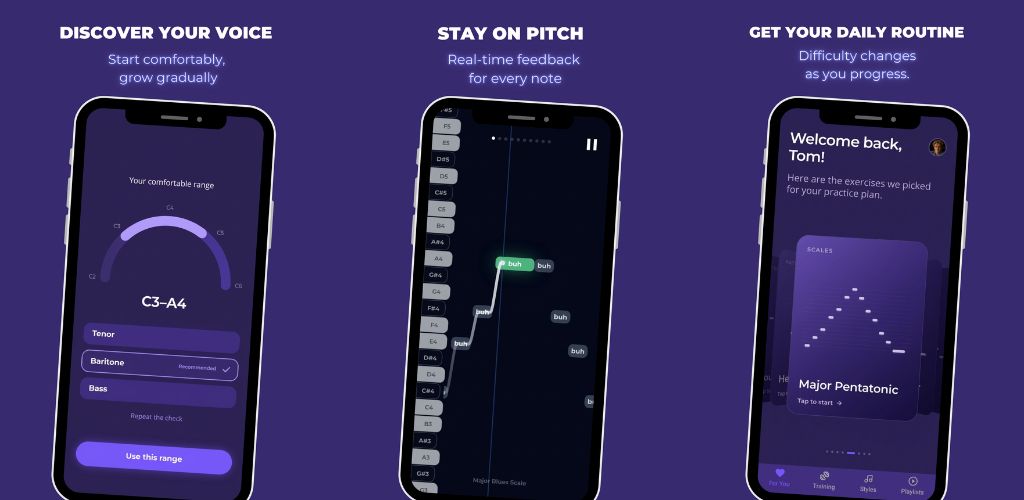
- Voice Tuner (5 exercises). Target notes scroll across a piano-roll style display and turn green the moment you are on pitch, so you get instant, visual feedback. This is the pitch-matching side of singing; if you are new to it, how pitch matching games work explains what it trains.
- Styles (3 exercises). Guided exercises where a vocal coach shows the technique on video and you practice along with playback, without the tuner.
- Voice Range Check. Before you start, you sing a comfortable low and high note and get a recommended starting range, so the exercises sit where your voice actually is.
Is that enough? For getting started, we think yes. The free exercises are the simpler, beginner-level ones, which is exactly what you need to build a first routine: a few minutes a day, with real feedback, in a range that feels comfortable. If those exercises help you and you want to go deeper, more professional, and across Pop, Musical Theatre and Classical, that is what Premium (€9.99/month or €39.99/year) unlocks: all 30+ training videos, offline use, and unlimited favorites.
That is a deliberate trade-off, and we would rather say it plainly: the beginner material is open so you can judge the approach, and the deeper material is what the subscription pays for.
What setup looks like: your first five minutes
Before you sing anything, Time to Sing asks a few questions, so the free exercises start in the right place instead of being one-size-fits-all:
- Why do you sing? You tell the app your goal, so it knows what you want from practice.
- Male or female voice. You pick one to set a sensible starting point.
- Your voice type. You choose the type that fits you.
- Not sure? Find your comfortable range. If you do not know your voice type, the Voice Range Check works it out: you sing a comfortable low note and a comfortable high note, and the app recommends a starting range.
- Sing your first exercise. After a short exercise, the app takes you to a page of exercises picked for you, ready to practice every day.
You do not need to know anything about voice types before you start, and you do not have to guess. The whole point is that the first session ends with a daily practice list that fits your voice, which is what turns a free app into a routine.
Vanido: the fully free option
Vanido is free and offers three short, personalized exercises a day, adjusting difficulty automatically. There is no curriculum and no karaoke, so it works as a light daily habit for range and accuracy. Reviewers describe it as a solid free pocket coach for quick feedback, but light on explaining technique in depth.
Good for: a zero-cost daily drill when you do not need structured lessons.
SingTrue: free ear training, iOS only
SingTrue is a solfège-style ear-training app: over 30 exercises use the microphone to score how accurately you match a target note. It is free to download with in-app purchases ($0.99–$7.99). It is also the oldest app here, with its most recent visible version dating from 2016, and it has no Android release.
Good for: iPhone users who mainly want to find out whether they can match pitch, not learn vocal technique.
Perfect Pitch: free to download, early paywall
Perfect Pitch is a gamified pitch-matching app for iOS. It is free to download with in-app purchases, but App Store reviewers report a paywall shortly after signup. Treat it as a trial rather than a free tool.
Good for: iOS users who want a light pitch game and do not mind paying early.
Simply Sing: song-first, paywalled from the start
Simply Sing adapts a big song catalog to your range with real-time feedback, but reviewers report no free songs, with pricing around $12/month or $60+/year. If you are searching for a free alternative to it, the apps above are the realistic options.
Good for: people who already know they want song practice and are happy to pay for it.
How to choose a free singing app
- Want technique and structure? Time to Sing's free tier, because the exercises come with coach video and range matching.
- Want a free daily habit with nothing to pay? Vanido.
- Want to test your pitch accuracy only, on iPhone? SingTrue.
- On Android? Time to Sing or Vanido. SingTrue and Perfect Pitch are iOS only.
Whatever you pick, check three things before you commit: what exactly is unlocked for free, whether the free part is time-limited, and whether it works on your phone. For the full picture of paid and free apps side by side, see the 2026 singing app comparison.
Download Time to Sing and try the free exercises, no payment needed to start.
FAQ
What is the best free singing app?
It depends on what you want. For structured technique with real-time feedback, Time to Sing's free tier. For a fully free daily drill, Vanido. For iOS-only ear training, SingTrue.
Are there free apps like Simply Sing?
Simply Sing is song-first and paywalled, so there is no direct free match. Vanido is free for daily practice, and Time to Sing offers a free tier built around technique rather than song practice. See Simply Sing alternatives for the differences.
Can I learn to sing with a free app?
You can start. A free app can help you find your range, practice matching pitch and build a daily habit. For deeper technique, such as registers, belting and style work, most people eventually need more material than a free tier offers, or a teacher.
Which free singing apps work on Android?
Time to Sing and Vanido. SingTrue and Perfect Pitch are iOS only.
How much does Time to Sing cost?
The free tier costs nothing and includes 5 Voice Tuner exercises and 3 Styles exercises. Full access is €9.99/month or €39.99/year.

