Pitch Matching Game: How to Train Your Singing Pitch on Your Phone
 By Kirill Zolygin
Short answer: A pitch matching game plays or shows you a target note, listens to your voice through the microphone, and tells you in real time whether you are on it, too low, or too high. It trains the loop that every singer needs: hear the note, produce it, check it, correct it. It does not give you "perfect pitch" (that is a different skill), and by itself it will not fix the reason you go off pitch. Used for a few focused minutes a day, together with some technique work, it is one of the fastest ways to improve your intonation.
What is a pitch matching game?
The idea is simple, and the format is the same in almost every app:
- A target note appears. It is played back as a tone and/or shown on screen, as a single note or a short sequence.
- You sing it. The microphone picks up your voice.
- The app detects your pitch many times per second and compares it with the target.
- You get instant visual feedback. Usually this is a line or dot that moves with your voice, plus a color or score when you land on the note.
That feedback is the entire point. When you sing in the shower or along to the radio, your ears have to judge your own accuracy, and most beginners cannot do that reliably. A pitch matching game puts a second, objective listener in the room.
Pitch matching vs. perfect pitch
These two phrases get mixed up constantly, and many people searching for a "perfect pitch game" actually want pitch matching.
| Pitch matching | Perfect (absolute) pitch | |
|---|---|---|
| What it is | Singing or recognizing a note relative to a reference you can hear | Naming or producing a note with no reference at all |
| Can you train it? | Yes, with practice | Very rare in adults and not something a game reliably builds |
| Does a singer need it? | Yes, this is the core skill of staying in tune | No. Most professional singers do not have it |
So if you cannot name a note by ear, that is completely normal and not a barrier to singing in tune. What you need is relative pitch accuracy: hearing a note and getting your voice onto it. That is exactly what the games train.
What a pitch matching game trains well
- Ear-to-voice coordination. The link between what you hear in your head and what your vocal cords actually do. This is the main reason people "can't hold a tune".
- Self-correction speed. Seeing that you are a little flat teaches you what "a little flat" feels like, so you start catching it yourself.
- Starting on the right note. Many pitch problems are really entry problems: the first half-second of a note. Games make that visible.
- Sustaining a note. Watching a line drift down shows you when your breath runs out or your support drops.
What it does not fix on its own
This is the part most pitch games skip. If you are consistently off pitch, the cause is usually one of these:
- Breath support. Weak or uneven airflow makes notes sag, especially at the ends of phrases.
- Tension. A tight jaw, tongue, or throat pushes pitch around.
- Register shifts. Many singers go flat or crack at the break between chest voice and head voice.
- Singing outside your comfortable range. If the target is too high or too low for your voice right now, no amount of matching practice will feel good.
A game can show you the problem. Fixing it takes a technique, which is why a pitch tool works best when it is paired with actual vocal instruction. We cover the "why" behind the two main registers in why your voice has two engines.
A 10-minute pitch matching routine
You do not need long sessions. Short, consistent practice beats a weekly hour.
Minutes 0–2: Warm up. Gentle humming and lip trills, sliding up and down. Do not start matching notes with a cold voice.
Minutes 2–4: Single notes in your comfortable range. Pick three or four notes in the middle of your range. Sing each one, hold it for four to five seconds, and watch whether you land on it immediately or slide into it. Aim for landing cleanly, not for scoring.
Minutes 4–7: Short note steps. Move to two- and three-note patterns, going up by a step and back down. Slow and accurate is better than fast and approximate. If you miss, do not chase the note. Stop, listen to the target again, and re-enter.
Minutes 7–9: Hold and sustain. Take one easy note and hold it as steady as you can for eight seconds, breathing low and keeping your shoulders relaxed. Watch the pitch line for drift.
Minutes 9–10: Cool down. Light humming on a comfortable note. Stop while your voice still feels fresh.
A few rules that make the practice work:
- Start inside your range, not at its edges. Matching a note you cannot comfortably reach trains strain, not accuracy.
- Do not strain to "hit" a note. If you push, your pitch gets worse and your voice gets tired.
- Practice daily, briefly. Ten focused minutes a day is more effective than one long weekend session. If building the habit is the hard part, see how to build a daily practice habit.
What to look for in a pitch matching app
- Real-time feedback, fast enough to feel connected to your voice, not a score shown after you finish.
- Targets that fit your range. A good app finds your comfortable low and high notes first and builds exercises around them.
- A clear display. You should see at a glance whether you are flat, sharp, or on the note.
- Something beyond the game. Matching drills without technique guidance tell you that you are off, but not why.
- A fair way to try it. You should be able to test it before committing to a subscription.
Where Time to Sing fits
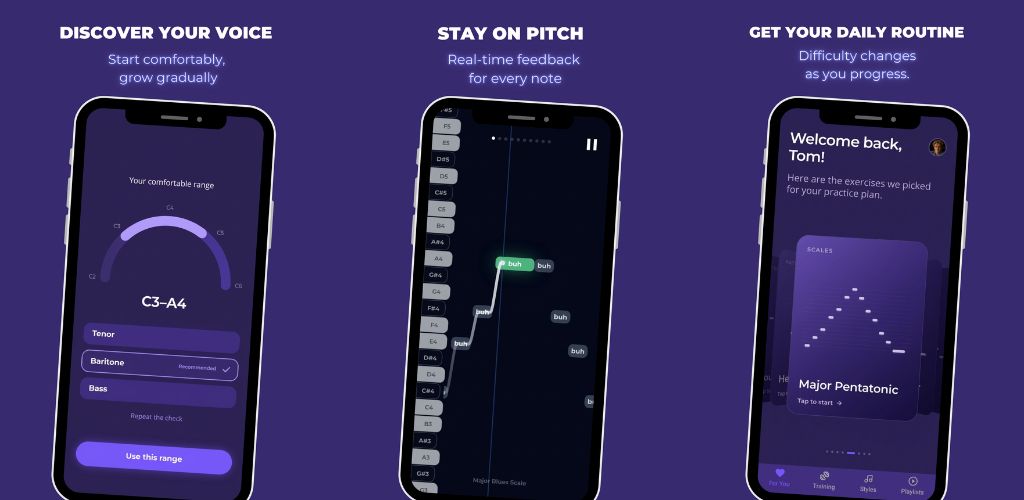
Time to Sing's Voice Tuner is a pitch matching tool built for singing: target notes scroll across a piano-roll style display and turn green the moment you are on pitch, with exercises matched to your range from the Voice Range Check. Unlike a standalone game, it sits next to a technique curriculum: a vocal coach demonstrates breath support, chest voice, mix, and head voice on video, and style tracks cover Pop, Musical Theatre, and Classical. So when the tuner shows you drifting flat at the end of a phrase, the course shows you how to fix it.
There is a free tier on iOS and Android, so you can try the approach first. Full access to all training videos is €9.99/month.
If you are comparing options, we put the main apps side by side in the 2026 singing app comparison, and cover one gamified alternative in Perfect Pitch Alternative.
Download Time to Sing and try the Voice Tuner for yourself.
FAQ
Is there a free pitch matching game?
Yes. Several apps offer a free tier or free sample exercises, and Time to Sing's free tier lets you try the training approach on iOS and Android before you pay. Check what each free version actually includes, since some limit the number of exercises or lock features early.
Can I play a pitch matching game online, without installing anything?
Browser-based versions exist, but results depend heavily on your device microphone and room noise. A phone app held close to your mouth in a quiet room is usually more accurate, and it is easier to practice daily.
Will a pitch matching game give me perfect pitch?
No. These games train relative pitch, the ability to match a note you can hear. Perfect (absolute) pitch is a different, rare ability. You do not need it to sing in tune.
How long until I improve?
Most people notice they land on notes more cleanly after a few weeks of short daily practice, but this varies a lot with your starting point and how consistent you are. Pair the game with breath and register work for the best results.
Why do I sing flat even when I hear the note correctly?
Usually it is a technique issue, not an ear issue: low breath support, tension, or an uncomfortable range. The game helps you see it; technique training helps you fix it.
Is pitch matching only for beginners?
No. Experienced singers use pitch tools to check intonation on difficult intervals, passages, and register transitions.

