
Voice Tuner Exercise Categories: Breathing, Intervals, Patterns & Scales
Explore the core training categories in the Voice Tuner: Breathing & SOVT, Intervals, Patterns, Scales, and how category filter chips streamline your daily practice.
The Time to Sing Voice Tuner library is organized into targeted training categories. Each category trains a specific pillar of vocal technique — from foundational airflow and relative pitch to register blending and full-range agility.
Filtering by Category Chips
When you open the Training tab, you have complete freedom to practice whatever technical focus your voice needs today.
At the top of the catalogue, a horizontal rail of category chips lets you filter exercises in a single tap:
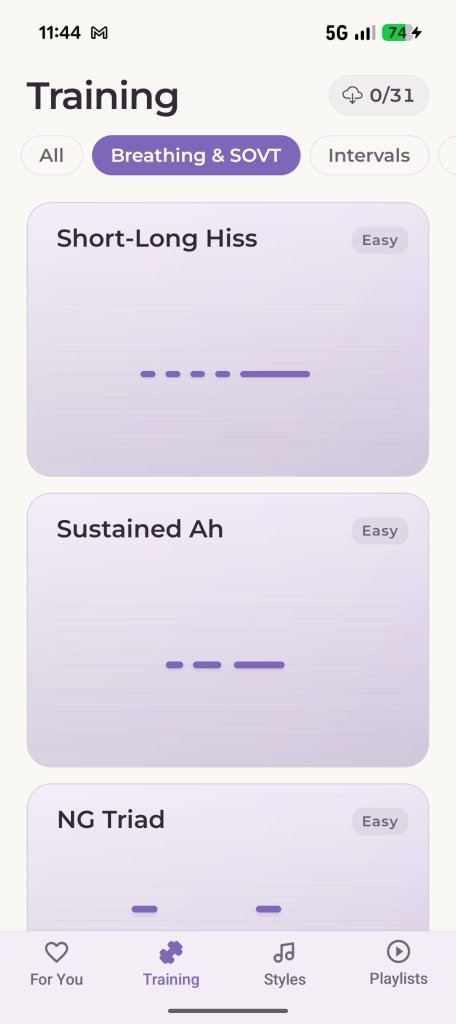
Category Filter Chips in Training
Tap any chip to isolate exercises for breathing, intervals, patterns, or scales.
- "All": Displays the entire training catalogue organized by sections so you can browse freely.
- Dedicated Chips (Breathing & SOVT, Intervals, Patterns, Scales): Filters the view to show only exercises in that specific category — perfect when you want to spend 10 minutes focused exclusively on breath management or ear accuracy without distraction.
- Melodic Previews & Difficulty Badges: Each card displays a simplified preview of the melodic line and a difficulty badge (Easy, Intermediate, Pro / Levels 1–3) so you always know the technical demand before starting.
1. Breathing & SOVT (Atmung)
Breathing and semi-occluded vocal tract (SOVT) exercises build the physical engine of singing: steady airflow, diaphragmatic engagement, and gentle vocal fold closure without throat tension.
In this category, exercises focus on:
- Diaphragm & Airflow Management: Sustained breath pressure drills that train your lower core muscles to support steady airflow rather than releasing all air on beat one.
- Gentle Vocal Fold Vibration: Semi-occluded sounds that create back-pressure in the vocal tract, helping your vocal folds vibrate freely and cleanly without throat constriction.
- Acoustic Breath Feedback: The interactive breath visualizer tracks your continuous volume and airflow in decibels, highlighting breath consistency and spotting gaps.
2. Intervals (Intervalle)
Relative pitch (relatives Gehör) is the ability to recognize and cleanly sing the exact distance between notes. Melodies are built from steps and jumps; interval training teaches your ear and larynx to measure those distances accurately.
In this category, exercises focus on:
- Step-Wise Foundations: Whole steps and half-steps that build clean intonation in your natural speaking range.
- Harmonic Pillars: Thirds, fourths, and fifths that anchor your ear within major and minor keys.
- Wide Jumps: Octaves, sixths, and sevenths that train pitch anticipation and prevent throat gripping when jumping across registers.
3. Patterns & Triads (Patterns)
Melodic patterns, triads, and arpeggios develop vocal agility, muscle memory, and seamless register blending (mix voice).
In this category, exercises focus on:
- Ascending & Descending Triads: Building effortless agility and forward tone placement across musical chords.
- Register Blending (Mix Voice): Connecting your lower chest resonance with your upper head resonance so you can sing through the passagio (vocal break) without cracks or sudden volume shifts.
- Vowel Coordination: Training narrower and taller vowel shapes that keep higher notes compressed, focused, and free of strain.
4. Scales (Tonleitern)
Full-scale exercises train stamina, smooth legato line, and precise intonation across your entire vocal compass, paying special attention to half-step precision on descending lines.
In this category, exercises focus on:
- Full Diatonic Compass: Major and minor scales that test breath pacing and vocal stability across full octaves.
- Stylistic Scales: Blues and contemporary scales that train micro-intonation, blue notes, and modern stylistic agility.
- Legato & Sustained Flow: Connecting notes into one continuous stream of resonance without sliding or losing pitch center.
Styles Melodies in Voice Tuner
In addition to core vocal technique, selected melodies from the Styles masterclasses are also available inside the Voice Tuner:
- If you find an unfamiliar interval or phrase in a Styles backing track difficult to grasp by ear alone, you can practice its visual version here.
- The scrolling Piano Roll and real-time pitch ribbon let you see every note transition, helping you lock in muscle memory before returning to the full instrumental backing track in the Playlists tab.
Difficulty Levels (Levels 1 to 3)
Every exercise card features a clear difficulty indicator:
- Level 1 (Easy / Beginner): Gentle step-wise motion, sustained tones, comfortable tempos, and central vocal range.
- Level 2 (Intermediate): Medium leaps, minor and blues tonalities, syncopated rhythms, and initial register transitions.
- Level 3 (Pro / Advanced): Full-range arpeggios, wide intervals, rapid tempos, and advanced vocal styling.